// BLOG_PROTOCOL  ·  INCOMING

Notes from the frontier.

Essays on applied AI, agentic systems, biotech and deep-tech strategy — by Christopher Yamba.

Coming soon:

APPLIED AI AGENTS BIOTECH DEEP TECH

// LATEST_POST

Coming next 26 October 2026

Coming next: DNA2C Labs, an experimental edition for power users.

We are exploring DNA2C Labs, a separate and experimental edition of DNA2C for Windows PCs. It turns DNA into something you can explore visually: rotate a double helix built from real sequence, zoom from a whole genome down to one letter, see the predicted 3D shape of the protein a gene builds, and simulate how DNA is reshuffled between parents and children.

Labs is being designed around Carbon-X, an open model published by HuggingFaceBio on Hugging Face that reads DNA and English together. It is small enough to run on a capable graphics card, so the DNA tutor runs on your own PC and your DNA never leaves it. Carbon-X is a research model and has not been clinically validated, so in Labs its answers are labelled as model output and shown beside facts from public databases. Labs is educational and exploratory, not medical advice.

There is no release date or price yet. The interactive prototype runs in your browser on a synthetic sample genome, and the waiting list is open.
// EARLIER_POST

Mathematics 24 October 2026

Five diagonals for tripled letters: a conjecture proved a day later.

Yesterday’s paper ended with a conjecture: if the inner letters of a word occur at most n times, the counts of length at most n + 1 determine its Parikh matrix. It proved n = 2. Version 2, now titled Four diagonals for doubled letters, five for tripled, proves n = 3.

The new idea is a pivot letter: every occurrence of a long pattern passes through exactly one copy of a middle letter, so part of the matrix factorises through its copies. A small determinant gives the missing count, and a finite lemma handles the rigid cases. The theorem is local, explicit pairs of words show where it stops, and both completeness theorems are proved in Lean 4.

What is new in version 2: Theorem D, Corollaries 1.2 and 1.3, Section 6 and Proposition 7.1; old Sections 6–7 and Table 1 are now Sections 7–8 and Table 2; Remark 3.2 is corrected. Version 1 stays available. The results were developed with the assistance of an agentic AI harness, with AI skeptics and referees; the responsibility is mine. Corrections and questions are welcome at christopher.yamba@yambacode.com.

// EARLIER_POST

Mathematics 23 October 2026

Four diagonals suffice: machine-checked mathematics from an agentic research loop.

In 2006 my degree thesis read the Parikh matrix of a permutation diagonal by diagonal. A Parikh matrix counts the scattered subwords of a word made of consecutive letters. The thesis proved that the third diagonal, the pair counts, determines the whole matrix. Twenty years later I took the question to words with repeated letters, working with an agentic AI research loop: explorers, skeptics, referees and a Lean 4 prover.

The result is Four diagonals suffice. If every letter except the first and the last occurs at most twice, the first four diagonals determine the matrix. The proof rests on two explicit rules, a rectangle rule and a crossing chain, and is formalised in Lean 4 at the level of words, with no gaps. A family of examples shows exactly where the pattern stops, and its counts include the Catalan numbers. The companion paper, From Euler numbers to the golden ratio, asks which matrices are shared by the most words. The answers run from Euler numbers to a threshold asymptotic to the golden ratio.

Every computational claim ships with a check, and the sources and Lean proofs are in the Yamba AI Math repository. These are author-published preprints, not peer reviewed. The tools assisted, and the responsibility is mine.

// EARLIER_POST

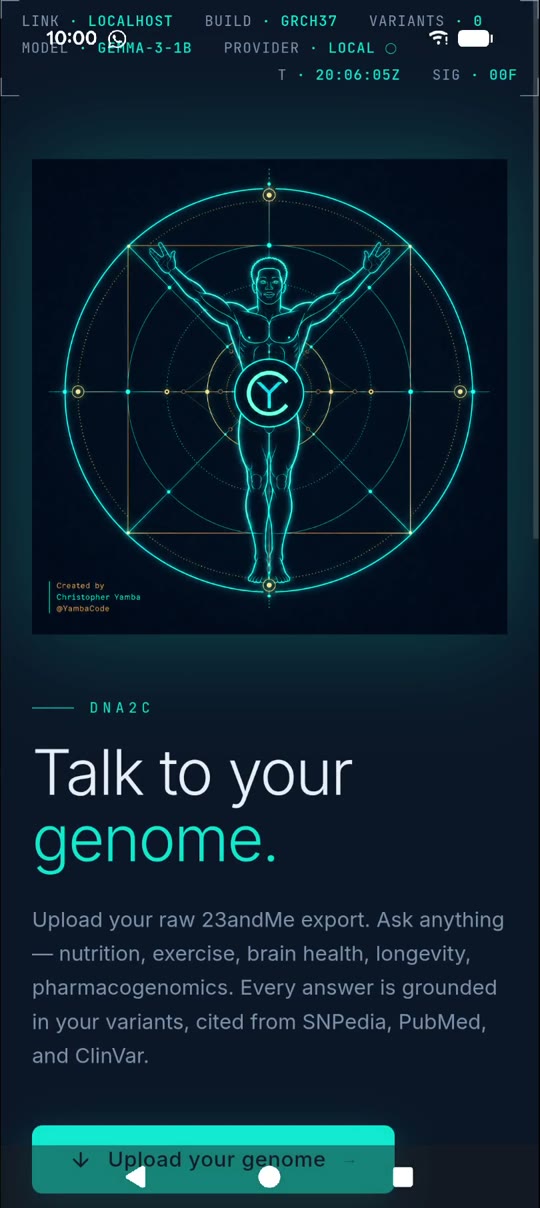
DNA2C running on a phone — talk to your genome
Product launch July 2026

DNA2C is now on Android — a private genomics agent in your pocket.

Almost every consumer DNA app works the same way: you hand your genome to someone else's server. DNA2C flips that. The whole thing runs on your phone — a small local AI model (Gemma) does the reasoning on-device, so your DNA and your questions never leave the handset.

Upload your raw 23andMe or AncestryDNA export and it's parsed locally in seconds. Then you just ask — “what's my caffeine metabolism genotype?”, “anything notable in my sleep variants?” — and DNA2C answers from your own variants, with citations from SNPedia, PubMed and ClinVar. No account needed to start, and it's free while in early access.

It's available now as a direct download ahead of the Google Play release. Watch the 60-second demo, then grab the app.